Changing the spectrum
changes the score.
Does it change the ordering?
The speech study exposed an inverse excited–sad valence ordering. We followed it with an acoustic intervention: keep source timing and phase, vary the upper-harmonic envelope and the residual separately, then evaluate every complete recording through MI.
A higher score is not a repaired ordering.
Mean native valence rises from 0.139 to 0.435 with cello-derived envelopes and 0.437 with viola-derived envelopes. Yet excited remains below sad in all 588 primary paired comparisons.
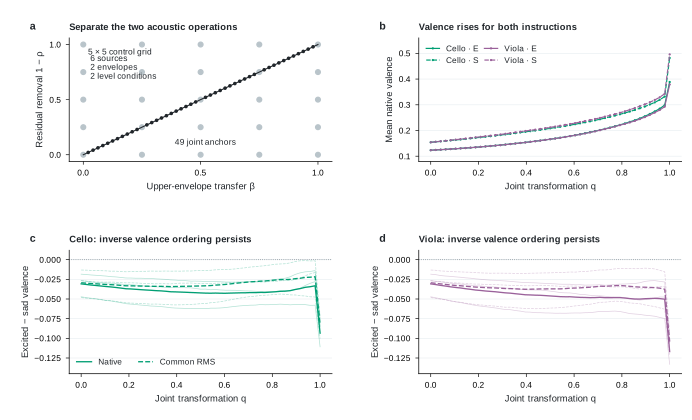
Six complete source recordings; three fixed text pairs; two instrument-derived envelopes; 49 joint anchors and a separate 5 × 5 control grid. Thin curves retain individual text pairs. The 588 comparisons share these six sources; they are not independent participants.
The residual and the consonance block carry most of the shift.
Residual removal alone changes mean native valence by +0.221. Envelope transfer alone changes it by +0.015 to +0.016. Restoring source consonance features suppresses 94.8% and 94.2% of the joint endpoint rises.
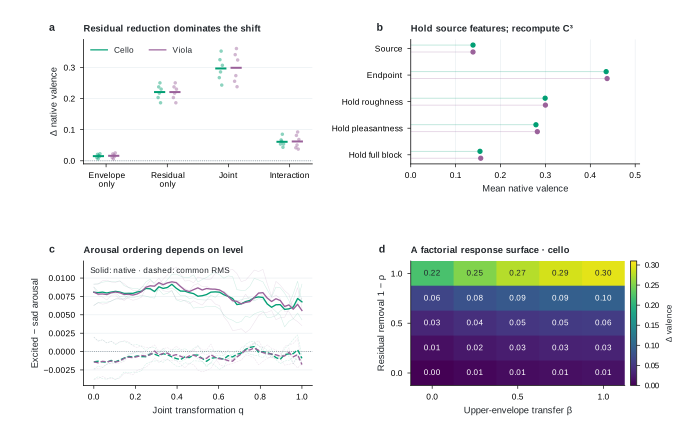
The signal decomposition is not a phoneme segmentation: residual attenuation does not selectively remove consonants. Feature holds diagnose the implemented computation. Arousal ordering also depends on level: excited exceeds sad in 294/294 native comparisons, but 94/294 under common RMS.
The response is distributed—and the boundary is numerically sensitive.
IUCP, SDNPS, ESME and SLEE show the largest native cello path changes. At residual retention 10⁻⁴, waveform differences are −86.7 to −81.8 dB RMS relative to the endpoint, yet the largest valence gap is 0.1073.
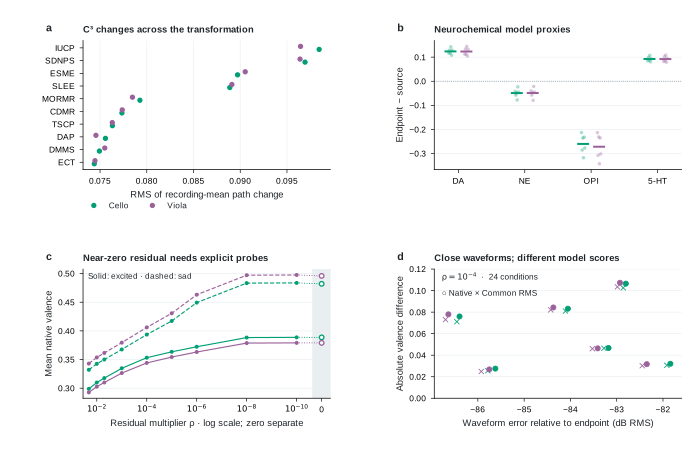
192 additional boundary evaluations reveal a sensitive final interval. One of their 96 paired contrasts is weakly positive (+0.000634), then negative again at the endpoint. This qualifies the primary-grid result; it is not a consistent recovery, a perceptual threshold or a neural measurement.
What this adds
to the speech study
The first study established a separation between decodable instruction information and native affect direction. This intervention identifies a strong dependence of absolute valence on the consonance feature block, while leaving the inverse instruction ordering unresolved.
It also exposes a numerical sensitivity that a smooth-looking morph curve would hide. Music-to-speech cue weighting remains a testable explanation; these data do not establish consonant-specific causality or human perception.
The six sources are selected recordings from Study 1, not six independent voices. Primary anchors share these sources. The intervention uses instrument-derived envelopes, not natural instrument performances. All raw arrays and the earlier study are preserved in the local research archive.