Relational Bayesian Inference for Musical Pleasure: An Experimental Protocol
Recruitment, preregistration and ethics review are pending. No human results are reported. The current PDF is the version.
Abstract
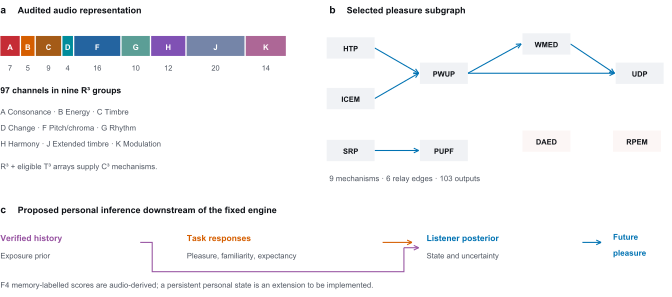
Can a listener’s response to a question about familiarity or expectation improve the prediction of their subsequent musical pleasure? This protocol proposes a test within Musical Intelligence (MI), using a fixed audio representation and a Bayesian observation model with a persistent listener state. History, direct pleasure reports and auxiliary responses enter separate comparisons, allowing the contribution of relations between tasks to be estimated on the same listening trajectory. Predictions are committed before each listening block and evaluated on later reports. A conditional Gaussian example establishes when an auxiliary observation can reduce predictive uncertainty, while a wrong-sign example shows how an incorrect relation can worsen prediction. The experimental design couples this comparison to a separate, controlled search for associations beyond the dimensions already labelled as pleasure-related. It specifies stimulus provenance, temporal alignment, model controls, held-out source families and simulation-based planning. The personal inference layer and experiment are proposed extensions; the figures show source-audited architecture, analytic calculations and synthetic examples, not participant results.
Version history
The record stays at this address. Each PDF preserves the version cited.
- Draft · CurrentCite this version ↓
Replaces the Learning the Listener editorial draft with a continuous experimental protocol: revised methods and five composite figures. Original PDF, unchanged.
- DraftCite this version ↓
Learning the Listener: A relational Bayesian experiment for musical pleasure, personal memory and discovery across dimensions
Initial draft in this library. PDF title metadata aligned with the cover; text and figures unchanged.