Can learned voice cues improve speech recognition in noise?
Spectrotemporal profiling and individualized auditory training
Abstract
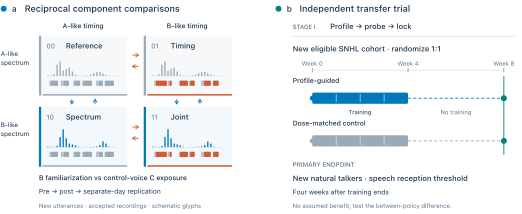
Familiar voices can improve speech recognition in noise, but this benefit does not identify which learned acoustic features are useful or how to train them. We propose a speech study in adults with sensorineural hearing loss. A measured bank of pre-generated utterances will support contrasts in spectral structure and segmental timing, with fundamental frequency constrained. Randomized familiarization, reciprocal component comparisons and separate-day replication will test learning-dependent cue use. A subsequent trial will compare profile-guided training with equally intensive control training. Its primary endpoint is recognition of new natural talkers four weeks after training. Clinical efficacy and the incremental predictive value of Musical Intelligence will be evaluated separately.
Prospective protocol. Stimulus qualification, pilot, ethics approval and preregistration precede confirmatory data collection. No human results are reported. The current PDF is the version.
Supporting materials
Editable manuscripts and editorial checksZIP ↗Original web articleWeb ↗Explore the stimulus space · Interactive 3DExplore ↗Editable sources and verification · Music & SpeechZIP ↗Version history
The record stays at this address. Each PDF preserves the version cited.
- Draft · CurrentCite this version ↓
Revised prose and headings. Study specifications, equations, references and figure artwork retained. Four pages, including references. Two numbered figures and the unchanged 3D companion with its interactive web link.
- DraftCite this version ↓
Four pages including references, which follow the final material. Original text, tables, figures and references retained. Two numbered figures plus the original stimulus-space companion and its live 3D link.