Reference-dependent C³ responses and readout constraints in birdsong-to-music transformations
An interactive computational experiment
Abstract
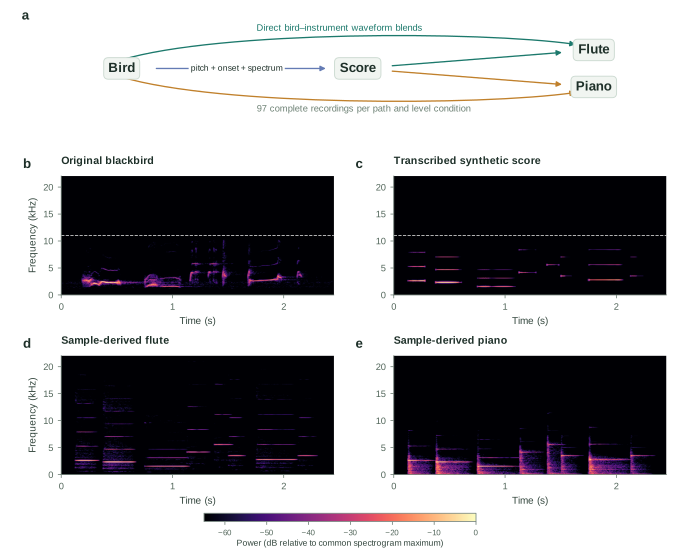
Spectral and temporal transformations of natural sounds offer a controlled test of the acoustic distinctions encoded by auditory cognition models. Here, we characterized the responses of C³, the cognition layer of a frozen version of Musical Intelligence (MI), to transformations of a single 2.45-s blackbird phrase. Five paths connected the recording, a synthetic transcription and sample-derived flute and piano endpoints. We analysed 1,146 complete-phrase renderings, including level controls, across 84 mechanisms and 202 present-state dimensions. With whole-phrase audio levels matched, the root-mean-square (RMS) model displacement was larger for piano than flute from the transcription (0.136 versus 0.098), but larger for flute than piano from the bird recording (0.065 versus 0.052), despite identical instrument endpoints. Spectral replacement elicited greater displacement than isolated pitch or onset transformations, and their joint effects were non-additive. Refinement to 97 anchors stabilized mechanism rankings, while interpolation errors remained 4.4–19.6% of path RMS. Formula inspection linked prominent responses to sensory terms. A readout audit identified three terminal source mappings and showed that a constant opioid-labelled output and a nearly unchanged noradrenaline-labelled mean can conceal mechanism or temporal changes. These findings delimit reference-dependent model sensitivity and its derived readouts; their perceptual and biological validity remains untested.
Ongoing computational research. The present manuscript reports model responses from one source phrase. Prediction of listener judgments remains an open empirical question.
Supporting materials
Scientific supplement · readout sources, regional controls and full tablesPDF ↗Interactive experiment · sound transformations and C³ responsesOpen ↗Computed response data · 1,146 phrase renderingsJSON ↗Version history
The record stays at this address. Each PDF preserves the version cited.
- Research manuscript · CurrentCite this version ↓
Revises Fig. 6 and adds a nine-page scientific supplement: terminal readout sources, MORMR–OPI dissociation, NE temporal contrasts, and regional weighting and contribution controls. Primary C³ results and Figs. 1–5 are preserved; the original Fig. 6 is retained as Supplementary Fig. S1. No participant or neural measurements are added.
- Research manuscriptCite this version ↓
Reference-dependent C³ responses to birdsong-to-music transformations
Ten-page computational pilot with six figures. Academic layout and revised abstract; the numerical analysis and figure assets are preserved. No listener or neural measurements are reported.