Musical Intelligence: A Glass-Box Architecture for Computational Models of Music Listening
 Read paper · PDF ↗
Abstract
Musical Intelligence (MI) is an executable architecture for developing and testing computational accounts of music listening. It combines 97 named acoustic descriptors, explicit temporal operations and 84 mechanisms producing 889 output channels. Declared inputs, equations and execution order make modelling choices accessible to inspection and intervention. Offline evaluations combine computational audits, human comparisons, controlled birdsong transformations, and synthetic speech and song. A targeted temporal intervention changed only outputs reachable through declared dependencies. Across transformations of one blackbird phrase, a terminal output was reconstructed from archived intermediate inputs with a maximum absolute error of over 466,146 frames. Decomposition exposed opposing contributions hidden by recording averages. Human comparisons showed selected affective associations, with generally uncertain gains beyond dataset-specific controls. In an exploratory scan using one synthetic voice, matched ridge readouts classified 26 of 27 three-tag song requests from a selected mechanism and 19 of 27 from acoustic descriptors across held-out texts. The usefulness of combining output groups varied across tasks and readouts. Production tags denote synthesis instructions. MI provides explicit computational predictions whose perceptual, cognitive and biological interpretations can be tested against independent observations.
Supporting materials
Scientific SupplementPDF ↗Birdsong · shared mechanisms and TAR · current companionRecord ↗Birdsong · complete mechanism, TAR and readout analysesPDF ↗Speech and song mechanisms & layers · current companionRecord ↗Speech and song · complete inventory and measurement controlsPDF ↗Results and analysis recordsGitHub ↗Reproduction archive · v2.0.0Zenodo ↗Protocol and analysis-plan recordsOSF ↗Version history
The record stays at this address. Each PDF preserves the version cited.
- Author manuscript · CurrentCite this version ↓
Author-approved 17 October manuscript, with revised opening text and architectural evaluation, updated evidence figures, the complete 84-mechanism literature atlas and continuous page flow. The protected original Figures 1–5 and pages 2–5 remain unchanged.
- Author manuscriptCite this version ↓
Integrates the 16 October revised Birdsong study throughout the Abstract, empirical case studies, Discussion and Methods. Replaces Figure 9 within the same 183 × 112 mm artwork area with full-profile shared mechanism ranks, controlled TAR endpoints, literal 3D terminal-term trajectories and exact signed decomposition. Retains all other ten figures, matched speech/acoustic comparisons, original human-data findings, 134 references and previous editions. The manuscript remains 22 pages; the architectural R3 Supplement is historical, with the latest companion supplements linked separately.
- Author manuscriptCite this version ↓
Redesigns Figures 9 and 10 at approximately half their previous artwork area, using compact vector plots and meaningful 3D schematics. Preserves every plotted birdsong value and all speech percentages, correct/total counts and baseline gains. Improved page flow reduces the manuscript to 22 pages. Other nine figure assets, numerical results, all references and prior editions are retained.
- Author manuscriptCite this version ↓
Centers the original speech-and-song findings on individual mechanisms versus the same 15-descriptor acoustic baseline. Abstract, Results, Discussion and Figure 10 state percentages, correct/total counts, percentage-point gains and additional correct requests in four matched tasks. Processing-layer analyses explain the gains after the direct comparison. Retains the other ten figures, original human-data findings and prior editions.
- Author manuscriptCite this version ↓
Replaces the earlier speech interpretation, spectral-transfer analyses and Figure 10 with the 16 October original speech-and-song study. Integrates the complete 84-mechanism, 326-layer and 889-channel inventory, strong mechanism-specific tag distinctions and complementary output-layer contributions throughout the Abstract, results, Discussion and Methods. Updates the speech citation and numerical figure sources; preserves the other ten figures and original human-data findings. The architectural R3 Supplement remains historical; the current vocal companion provides its complete methods and Supplementary Information.
- Author manuscriptCite this version ↓
Integrates the latest birdsong and speech studies throughout the Abstract, Introduction, empirical case studies and Discussion. Adds two full-page evidence figures while retaining all nine original figures and existing human-data results. Methods follows References. The original R3 Scientific Supplement remains the historical architecture record; both companion studies provide their newer methods and complete analyses.
- Author manuscriptCite this version ↓
Integrates the single-phrase birdsong transformation assay into the Abstract, architecture, worked checks, Methods and Discussion. Adds Table 1 and Scientific Supplement S8. All nine main figures and existing human-observation results are preserved; the assay reports computational responses, not listener or neural measurements.
- Author manuscriptCite this version ↓
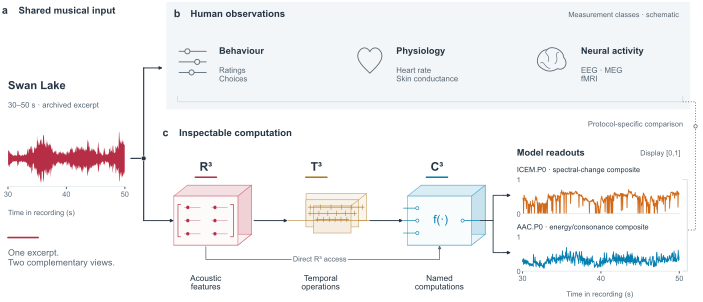
Revised 3D opening figure. Figure 1 now shows orthographic R³, T³ and C³ modules; all waveform and model-readout samples are preserved. The other 16 pages are unchanged from the preceding 3D edition.
- Author manuscriptCite this version ↓
3D figure edition. Figures 2, 4b and 5 revised with source-grounded geometry; numerical content and the other 14 manuscript pages are unchanged.
- Author manuscriptCite this version ↓
Architecture manuscript. Original PDF, unchanged.